
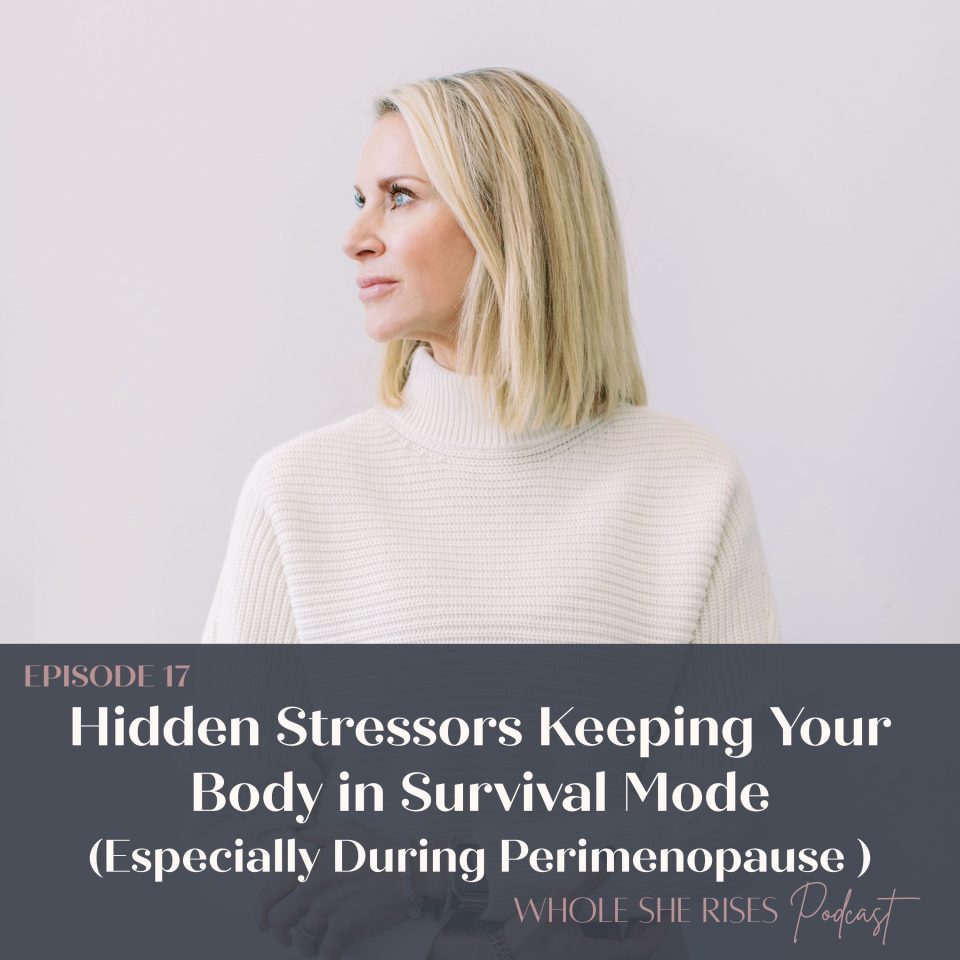
Why you still feel stressed when life is good. Learn how hidden stressors affect your nervous system in perimenopause & autoimmune healing—and how to start feeling calm again.
Have You Ever Felt Like Nothing Is Wrong… But Your Body Won’t Relax?
You’re doing the work.
You’re taking care of yourself.
You’re trying to slow down when you can…
And yet…
you still feel wired, overwhelmed, or just beneath the surface of burnout.
If that’s you, I want you to hear this—
it’s not because you’re doing something wrong.
It may be because of the hidden stressors affecting your nervous system…
the ones you don’t even realize are there.
For many women navigating perimenopause, autoimmune symptoms, and chronic stress, this is the missing piece.
When Life Looks Good But You Still Feel Stressed (A Personal Story)
There was a season in my life where—on the outside—everything looked good.
After years of trauma and uncertainty, I was living the life I had prayed for.
- A supportive husband.
- Healthy children.
- A career I had worked hard to build.
Life was stable.
There wasn’t a major crisis.
There was so much to be grateful for.
But inside… it didn’t feel that way.
I couldn’t fully enjoy any of it.
I never felt present.
I always felt slightly—sometimes intensely—on edge.
Like my body was bracing for something…
even when there was nothing there.
And I remember thinking:
Why can’t I just feel this?
Why can’t I settle into my life the way it is right now?
What I didn’t understand at the time was this:
My mind knew life was good…
but my body hadn’t caught up yet.
It was still living in old patterns—
survival, chaos, and anxiety.
And no one had ever taught me…
that your body doesn’t automatically update
just because your circumstances do.
What Are Hidden Stressors? (And Why They Keep You in Survival Mode)
When we think about stress, we often look for something obvious—
a major life event, trauma, or crisis.
But for most women, especially in midlife, that’s not the full picture.
It’s not one big thing.
It’s the accumulation of small, constant inputs
that your nervous system never fully gets a break from.
And the tricky part is—
these stressors often look completely normal.
Overcommitment and Nervous System Capacity in Midlife Women
Overcommitment isn’t always about doing too much.
It’s about doing more than your body has capacity for right now.
And that’s a very different thing.
You might be saying yes because:
- You care
- You feel responsible
- It’s what you’ve always done
But your nervous system isn’t measuring your intention.
It’s measuring load.
And when there’s no space to recover,
your body stays in a state of activation.
This is how burnout in perimenopause and midlife often builds—quietly and over time.
Constant Stimulation: Why Your Nervous System Never Fully Rests
We live in a world where there is almost no natural pause.
- Your phone.
- Social media.
- Email.
- Notifications.
- Background noise.
Even the things that are “good” for you—
like podcasts, learning, or personal growth—
still keep your nervous system engaged.
So even when you think you’re resting…
your body is still processing input.
And if there’s never a moment of true quiet,
your nervous system never fully downshifts.
It just stays… slightly on.
All day long.
Lack of Boundaries and Self-Overriding (A Hidden Stressor in Autoimmune Healing)
This one runs deeper than most people realize.
Boundaries aren’t just about what you say to others.
They’re about how often you override yourself.
- Pushing through when you’re exhausted
- Staying available when you need space
- Ignoring what your body is asking for
Every time that happens, your body learns:
“I’m not safe to slow down.”
And that message keeps your nervous system in a constant, subtle state of stress.
This is especially important for women navigating autoimmune conditions and hormone shifts, where the body is already more sensitive to stress load.
Why Your Body Won’t Relax (Even When You Try to Rest)
So many women ask:
“Why can’t my body just relax?”
“Why do I always feel on edge?”
The answer is often this:
It’s not that your body doesn’t know how to regulate.
It’s that it’s never being given the conditions to.
Even when you try to rest…
the background load is still there.
And your nervous system is always asking:
“Is this a safe time to let go?”
If the answer is consistently no…
your body stays in protection.
Not because it’s broken—
but because it’s doing exactly what it was designed to do.
How to Get Out of Survival Mode (Nervous System Awareness)
Instead of asking:
“What’s wrong with me?”
Try asking:
“What might my body be responding to that I haven’t noticed yet?”
Gently begin to notice:
- Where am I overextended—even in subtle ways?
- Where am I constantly stimulated without pause?
- Where am I not honoring my own limits?
Not with judgment.
Just with awareness.
Because awareness is where nervous system healing begins.
Small Shifts to Calm Your Nervous System and Reduce Stress
You don’t need to overhaul your entire life overnight.
But when you start to see these patterns,
you can begin to create:
- Small moments of safety
- Small reductions in stress load
- Small returns to yourself
And over time…
that’s what teaches your body:
“It’s okay to come out of survival mode.”
This is how you begin to feel:
- Calm
- Present
- Grounded
- Like yourself again
Work With Me: Nervous System Support for Midlife Women
If this resonates and you’re ready to feel more calm, regulated, and in control, here are a few ways to go deeper:
Back In Control Session (90-Minute Private Session)
A focused session to calm your nervous system and help you feel grounded and clear again.
👉 https://wholesherises.com/back-in-control-session
1:1 Coaching for Perimenopause & Autoimmune Healing
Deeper support for midlife women ready for lasting transformation through nervous system and mind-body work.
👉 https://wholesherises.com/work-with-mandi
Final Thought
You’re not broken.
Your body is responding—intelligently—to what it’s been given.
And when you begin to shift those inputs, even gently…
everything starts to change.