
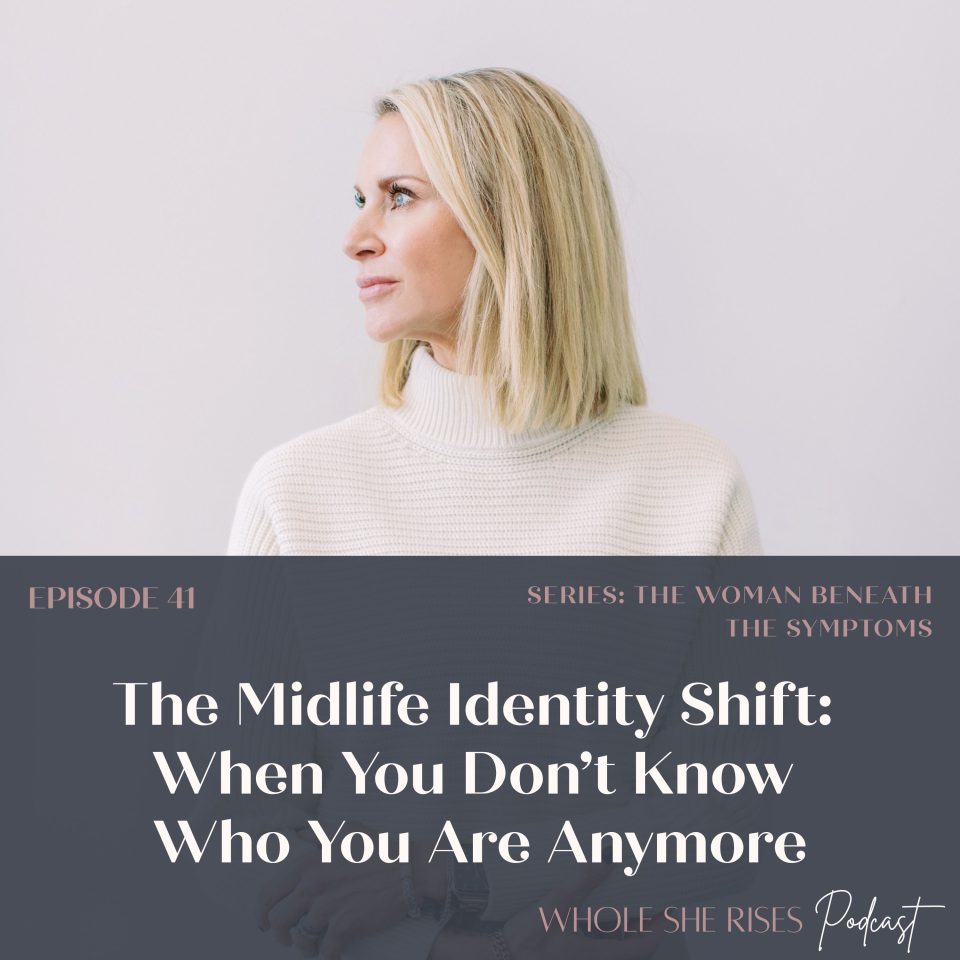
One of the most disorienting parts of midlife isn’t simply that your body changes.
It’s that the roles, abilities, relationships, and expectations that once helped you know who you were may begin changing at the same time.
Your children need you differently. Your body no longer responds in familiar ways. Your energy and emotional capacity shift. Your relationships evolve. Work that once felt meaningful may no longer hold the same appeal.
And somewhere beneath all of those changes, a question begins to rise:
If I’m not the woman I have always known myself to be, who am I now?
Midlife can feel like losing yourself. But perhaps you haven’t lost yourself at all. Perhaps you are standing somewhere between the woman you needed to be for so long and the woman you are becoming.
When Several Versions of Your Life Change at Once
This is what happened to me.
Around the same time I was dropping my oldest son off at college, my hormones were shifting. My body was changing. My energy was plummeting. My marriage was being affected by low libido and emotions I didn’t always understand well enough to communicate.
At the same time, I was beginning to lose my love for a career I had once been so proud to build.
I was also recognizing how often I had taken responsibility for other people’s expectations—even when those expectations were no longer aligned with what I believed I was supposed to carry.
I had to learn how to say no.
I had to learn how to disappoint people without automatically believing I had done something wrong. I had to let other people have feelings about my decisions without losing pieces of myself trying to make those feelings positive.
I also had to learn how to explain what was happening inside me to my husband in a way that didn’t cause him to question my love for him, even when I was still trying to understand it myself.
There wasn’t one clean moment when I could say, “This is the problem.”
It was more like several versions of my life were changing at once.
Beneath all of them was the same unsettling question:
If I’m not the woman I have always known myself to be, who am I now?
Maybe you are asking some version of that question too.
It’s Not Just Hormones
We often talk about midlife as though it is primarily a hormonal transition.
Hormonal changes absolutely matter. They can affect your mood, motivation, sleep, energy, cognition, emotional tolerance, confidence, libido, body composition, and chronic illness symptoms.
They can change how you feel in your body and how much capacity you have to manage everything happening around you.
But this season isn’t only about hormones.
Hormonal changes may also lower your ability to tolerate what you have been tolerating for years. They can make it harder to continue performing an identity that no longer feels true or maintaining a pace that may never have been truly sustainable.
And these hormonal changes rarely occur in isolation.
Your children are becoming more independent or leaving home. Your parents are getting older and may begin needing more from you. Your marriage and friendships are evolving. Your body no longer responds in the ways you expect.
You may be questioning a career you spent years building or discovering that the ambitions that once motivated you no longer carry the same meaning.
You may also be carrying health challenges, caregiving responsibilities, grief, emotional swings, or years of accumulated stress.
Somewhere in the middle of it all, you may become less willing—or simply less able—to override your own needs to keep everything running as it always has.
Rarely is there one isolated change that explains how you feel.
More often, it is the collision of many changes.
When enough of the external structures that once told you who you were begin shifting, your internal sense of identity can begin shifting too.
The Questions Busyness Helped You Avoid
Midlife can also expose questions that busyness once helped you avoid:
Do I actually want this life, or have I simply become very good at managing it?
What do I want the next half of my life to look and feel like?
How much of who I have been was built around being successful, useful, needed, admired, or approved of?
These are not small questions, and they rarely arrive at a convenient time.
You may be trying to answer them while your sleep is disrupted, your body feels unfamiliar, your children are growing up, your parents are aging, and you have less energy available for reinvention than you once did.
Proud—and Grieving at the Same Time
One of the clearest places we experience this identity shift is when our children begin growing up and needing us differently.
You know this was always the goal. You raised them to become independent, build lives of their own, and eventually leave home.
You are proud of them. You want this for them.
And it can still completely undo you.
You can celebrate the person your child is becoming while grieving the version of motherhood that is ending. You can feel excited about everything ahead of them and still ache because your family will never exist in quite the same way again.
Both can be true.
I have experienced this with my oldest son going to college. I am incredibly proud of him. I want him to grow, mature, follow God, and become independent.
But wanting that for him doesn’t mean I don’t miss him.
It doesn’t mean I don’t miss the version of our family in which everyone was still under the same roof each night. And it doesn’t mean my heart instantly knows how to adjust simply because my mind understands that this change is good.
Sometimes our children are ready for the next season before our hearts are ready for everything that season changes.
You aren’t only adjusting to your child’s growing independence. You may also be reconsidering what motherhood looks like now, where your sense of purpose comes from, and who you are when a role that organized so much of your life begins asking something different of you.
You are being asked to release one version of yourself and begin imagining another—
right when you may have the least energy, clarity, or emotional margin to do it.
The Quiet Load Beneath Everyday Life
Underneath these changes, there can be a kind of low-grade vigilance—a quiet emotional bracing that runs beneath everyday life.
No single thing feels significant enough to explain why you feel so unsettled.
It is more like a slow leak.
A child needs you less.
A parent needs you more.
Your body is changing.
Your sleep becomes lighter.
Your capacity is shifting.
Each change may seem manageable on its own, but together they add up.
Sometimes that accumulated load shows up in the body before you have words for what you are experiencing. Your shoulders feel tense. Your sleep becomes shallow or interrupted. You are tired, but you cannot fully settle.
That does not mean every symptom is emotional, that physical symptoms should not be evaluated, or that everything happening in your body is caused by stress.
But our bodies are affected by what we are living through—even when there is no single event that seems significant enough to name.
Sometimes we keep searching for one explanation when the fuller answer is that our bodies and minds are responding to many changes at once.
“I’m Fine”—And I’m Not
Many women never bring any of this up because it feels too small to say aloud.
How do you explain that you are grieving something good? How do you say that your child thriving is deeply rewarding but also breaking your heart a little? How do you explain that nothing is terribly wrong, but something within you is changing?
So when someone asks how you are doing, you say, “I’m fine.”
And you are.
But in some ways, you aren’t.
That does not make you ungrateful or dramatic. It means you are holding love, grief, pride, gratitude, change, and uncertainty at the same time.
Human beings are capable of holding more than one truth.
You can be proud and grieving.
Grateful and restless.
Deeply in love and still struggling with changes in intimacy.
Fine and not fine.
One truth does not cancel out the other.
A More Tender Question: What Do You Miss?
Sometimes “What’s wrong?” is too large a question.
It assumes there is one identifiable problem that needs to be fixed. But perhaps nothing is wrong in the way that question implies. Perhaps many things are simply changing.
A more tender question might be:
What do you miss right now?
Do you miss hearing everyone come through the door at the end of the day?
Do you miss the energy you once had or the feeling of being at home in your body?
Do you miss knowing exactly what your role was?
What you miss can reveal something about what you are grieving. It can also help you distinguish between a role that is changing and the deeper need beneath it.
Maybe you don’t only miss having your children at home. You may miss connection, nurturing, shared experiences, purpose, or feeling closely woven into their daily lives.
Maybe what you miss about your younger body is not simply the way it looked. You may miss trusting it or feeling free and at ease inside it.
Perhaps you miss your former career because it gave you a sense of competence and significance. You may miss being needed because it helped you feel purposeful. You may miss familiar routines because they provided stability and safety.
When you understand the deeper need beneath what you miss,
you can begin asking how that need might be honored in the season you are entering—
not by recreating the past, but by carrying forward what mattered most about it.
When a Role Becomes an Identity
When motherhood has organized your days, decisions, and emotional life, your children growing up does more than change your schedule. It can change the way you understand yourself.
You may find yourself asking:
Who am I when I’m no longer needed in the same way?
Can my relationship with my children change without believing my purpose is disappearing?
The same questions can arise around other roles.
Who are you when you no longer want the career that once made you proud?
Who are you when you are no longer willing to carry another person’s disappointment as evidence that you have done something wrong?
Throughout our lives, many of us learn to understand ourselves as the good girl, caretaker, achiever, dependable one, peacemaker, capable one, or strong one.
These qualities are not inherently unhealthy. Caring for people can be a genuine expression of love. Pursuing excellence can be deeply meaningful. Being responsible and dependable are beautiful qualities.
The problem begins when a role becomes the primary way we secure
love, safety, approval, belonging, worth, control, or purpose.
There is a difference between caring for people because you love them and believing you must take care of everything to remain lovable.
There is a difference between doing meaningful work and relying on achievement to prove your worth.
There is a difference between being dependable and believing everyone must always be able to depend on you, regardless of what it costs you.
A role can be a meaningful expression of who you are
without becoming the whole definition of who you are.
Why an Exhausting Identity Can Still Be Hard to Release
Even an identity that exhausts you can feel frightening to release.
That identity may have given your life structure, validation, predictability, belonging, or protection. When it begins to loosen, the questions underneath it can feel unsettling:
If I stop being the woman who always says yes, will people still value me?
If I am not constantly productive, am I still successful?
If I disappoint someone, am I still a good person?
If my body changes, am I still desirable?
If my children need me differently, where does my purpose come from?
If I change my mind about the life or work I want, does that mean my previous choices were mistakes?
I have wrestled with many of these questions.
Leaving my career did not mean the career had been a mistake. It did not erase what I learned, the relationships I built, or the ways that season shaped me.
Recognizing that another person’s expectations were no longer mine to fulfill did not make me uncaring.
Saying no did not mean I had stopped being dependable. Allowing my role with my son to change did not make me less of his mother. Struggling with hormonal changes did not mean I loved my husband any less.
But I had to learn those truths.
I had to learn that someone could be disappointed in my decision without my decision being wrong.
I had to learn that the end of one expression of my identity was not the end of my value.
Honoring the Woman You Were
There is grief in recognizing that you cannot remain exactly who you were.
You may grieve a younger body, your former energy and capacity, a version of motherhood, a career dream, a relationship dynamic, the life you assumed you would always have, or the woman who seemed able to keep pushing without feeling the cost.
You do not have to criticize that woman in order to grow beyond her.
She may have carried you through seasons that required her strength, competence, adaptability, and care.
You can honor her without requiring her to lead every season that comes next.
The Space Between Identities
Eventually, many of us find ourselves in an uncomfortable in-between.
We know something has changed, but we do not yet know what comes next. The old way no longer fits, but the new identity is not fully formed.
You may want something different without being able to explain what “different” means.
Because many of us are accustomed to doing, solving, and managing, our first questions tend to be:
What should I do next?
What is my new role?
What am I supposed to build?
How do I fix this feeling?
But perhaps a deeper question is:
Who am I becoming—and what kind of life would allow
that woman to be fully present?
The absence of an immediate answer does not mean something is wrong with you.
You may not be lost.
You may be standing in the space between who you once needed to be and who you are becoming now.
Perhaps that space does not need to be filled immediately. Perhaps it needs to be explored, listened to, and allowed to unfold.
Questions for the Woman You Are Becoming
If you recognize yourself in this uncertain middle, take a quiet moment to complete these sentences:
- What I miss is __________.
- What I’m proud of is __________.
- What I’m grieving is __________.
- What I’m afraid this change means about me is __________.
- What may be opening for me now is __________.
You do not have to choose between gratitude and grief.
You do not have to reject the woman you were in order to become the woman you are now.
And you do not have to rush into a new identity simply because the old one no longer fits.
Maybe you haven’t lost yourself.
Maybe the roles and strategies that once helped you feel safe, valuable, successful, or needed are beginning to loosen.
And maybe underneath them is an amazing woman you are finally ready to know.
Begin Finding Your Way Back to You
In the next episode, we will explore how to begin meeting the woman you are now—not through a dramatic reinvention, but by noticing what is still true about you, what feels alive, what you are becoming less willing to abandon yourself for, and what small choices could begin honoring the woman you are becoming.
If this has helped you recognize that you are standing somewhere between who you have been and who you are becoming, I created the Back to You Blueprint for you.
This free guide will help you begin connecting the dots between what is happening in your body, what you have been carrying, what no longer fits, and what you may need in this next season.
[Download the free Back to You Blueprint]
You can also watch this complete episode of Whole She Rises: