
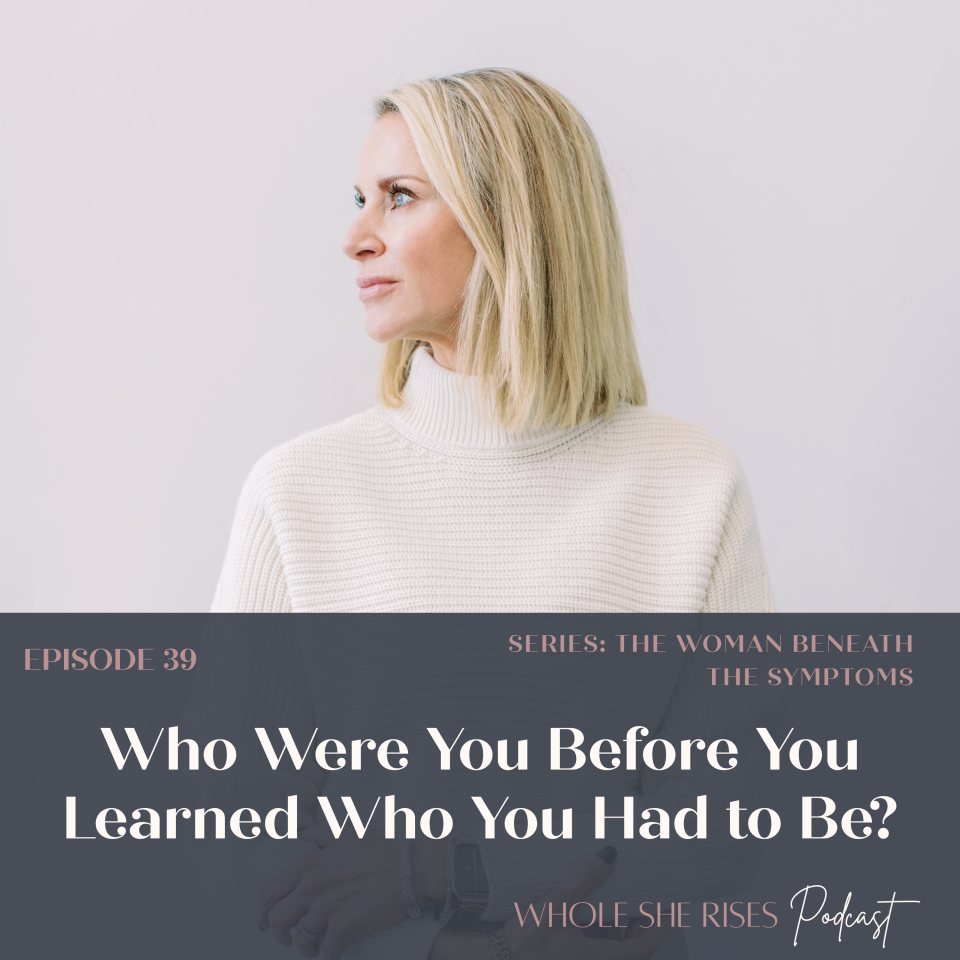
What if healing in midlife isn’t only about feeling better—but finally having enough space to discover the woman underneath the symptoms?
For a long time, I thought healing would mean getting my energy back.
Less pain. Better sleep. Being able to exercise again. Having enough energy to work, be with my family, and do the things I loved without constantly calculating how much they were going to cost me.
I thought healing would mean feeling like myself again.
And eventually, a lot of those things did happen.
Not perfectly. Not all at once. And certainly not in a straight line.
But my body became quieter.
I had more energy. More capacity. More room in my life.
And then something happened that I wasn’t expecting.
I started asking questions I hadn’t really had the capacity to ask before.
What do I actually want?
What matters to me now?
Why am I still doing some of the things I’m doing?
Do I actually want to go back to the same life I was living before my body forced me to slow down?
And maybe the biggest question of all:
Who am I when I’m not proving, performing, producing, taking care of everyone,
or trying to keep everything together?
Or maybe another way to ask it is:
Who was I before I learned who I had to be?
That’s the question I’ve found myself sitting with lately.
Because after spending so much time trying to understand the exhaustion, overwhelm, autoimmune symptoms, perimenopause, chronic stress, and a nervous system that seemed unable to settle, I’ve started to wonder if there’s another layer of healing we don’t talk about enough.
For many women, not feeling like yourself in midlife may be about more than the physical symptoms happening in your body.
What happens when the symptoms get a little quieter?
What happens when your body begins to feel safer and you finally have enough capacity to look beyond simply making it through the day?
Sometimes you discover that underneath all of those symptoms is a woman you haven’t really gotten to know in a very long time.
Maybe ever.
And I’m realizing I’m not the only woman asking these questions.
I hear it in conversations with friends. I see it in comments from women whose bodies and lives have changed. I see women making choices that don’t make sense to everyone around them anymore because they’re beginning to question identities, expectations, and roles they’ve carried for decades.
I think there might be something important happening here.
Maybe healing isn’t only about getting back to who we were.
Maybe it’s also an invitation to finally meet the woman underneath everything we’ve learned to be.
We Don’t Wake Up One Day and Decide to Lose Ourselves
When we talk about “finding ourselves again,” it’s easy for that language to sound as though everything that came before was somehow fake.
I don’t believe that.
Most of us didn’t wake up one morning and decide:
You know what? I think I’m going to spend the next thirty years ignoring what I need and becoming whoever everybody else wants me to be.
That’s not how it happens.
We adapt.
And we start doing it incredibly early.
As little girls, we’re constantly taking in information about what earns us connection, approval, safety, praise, belonging, or peace.
Every family is different. Every childhood is different. Every nervous system is different.
But somewhere along the way, maybe you learned:
Be easygoing.
Be good.
Don’t disappoint anyone.
Don’t cause conflict.
Be responsible.
Work hard.
Take care of people.
Achieve.
Keep going.
Don’t need too much.
Don’t be too emotional or too sensitive.
Don’t make things harder for anybody else.
We don’t necessarily recognize these as rules while we’re learning them.
We simply begin adapting ourselves around them.
And when a behavior helps us feel connected, accepted, safe,
or valued, we tend to keep doing it.
Eventually, something we learned to do can begin to feel like something we simply are.
When Serving Others Starts to Look Like Disappearing
I think there’s another layer to this for those of us who grew up in the church.
As Christian women, many of us learned very early that serving is good.
And it is.
We learned to help. To give. To take care of people. To put others before ourselves. To show up when someone needs us. To bring the meal, volunteer, care for children, support our husbands, help our families, serve our churches, and notice the person who might need something.
Those are beautiful things.
Jesus Himself modeled a life of service.
But sometimes—especially as women—the message we actually absorb can become slightly different:
Everyone else’s needs matter more than mine.
Taking care of myself is selfish.
If I can do it, I probably should.
A good Christian woman doesn’t disappoint people.
She doesn’t say no when someone needs her.
She just keeps giving.
And somewhere along the way, serving others can become so intertwined with our identity that we stop noticing when serving has turned into self-abandonment.
I don’t believe God asks us to become less loving, less generous, or less willing to serve.
But I also don’t believe He asks us to disappear in the process.
There is a difference between loving sacrifice and chronically overriding ourselves.
Learning to recognize that difference can require a lot of discernment.
When a Learned Behavior Starts Feeling Like Your Personality
Here’s where this gets especially interesting.
If you practice these patterns long enough, eventually they stop feeling like behaviors.
They start feeling like your personality.
You don’t think:
I’ve learned to be incredibly responsible because responsibility helped create predictability in my life.
You think:
I’m just a responsible person.
You don’t think:
I’ve learned to anticipate what everyone else needs because I feel safer when everyone around me is okay.
You think:
I’m just really good at taking care of people.
You don’t think:
I’ve learned to avoid disappointing people because their disappointment feels almost unbearable in my body.
You think:
I just love making everyone happy.
And I want to be careful here, because these qualities aren’t inherently bad.
Being responsible isn’t bad.
Being dependable isn’t bad.
Achievement and hard work aren’t bad.
Caring deeply about other people certainly isn’t bad.
I don’t want us to pathologize every beautiful quality we have simply because it may have been strengthened through difficult experiences.
So the question isn’t:
Is this trait good or bad?
The more revealing question might be:
Am I freely choosing this—or do I no longer know how not to be this?
There’s a difference between being generous because you genuinely want to give and being unable to stop giving because you’re afraid someone will be disappointed if you don’t.
There’s a difference between working hard because you care about what you’re building and not knowing how to rest because your worth has become entangled with what you produce.
There’s a difference between being dependable and believing everyone else’s needs automatically come before your own.
I didn’t understand that difference for a very long time.
And when I look back at my own story now, I can see just how early I began learning to override myself.
My “Good Girl” Story
I grew up genuinely loving Jesus.
I wanted to follow Him. I wanted to do what was right.
But I also grew up with quite a bit of instability.
And somewhere along the way, I think my genuine desire to please Jesus became entangled with something else:
Pleasing people.
I couldn’t have articulated that then. I didn’t know anything about nervous systems, attachment patterns, trauma responses, or people-pleasing.
I certainly wasn’t sitting around as a teenager psychoanalyzing myself.
I just knew I wanted to be loved.
I wanted safety. Stability. Acceptance.
And I think there was something underneath that desire that sounded a little like:
Maybe if I do this right enough…
Maybe if I make the right choice…
Maybe if I’m good enough…
Maybe if I keep everybody happy…
Maybe then I’ll feel secure in their love.
Beginning in my teenage years, the person standing in front of me slowly began to have more influence over my decisions than the God I couldn’t see.
For me, that person was a man.
I met him at church when I was fifteen. And I think there was probably some part of me that assumed, Well, I met him at church. This should turn into something really good, right?
But slowly, I began compromising.
Not through one giant, dramatic decision.
It happened in little pieces.
Pieces of who I was.
Things I really wanted.
Things I believed.
Things I knew somewhere deep inside weren’t right for me.
And little by little, I learned a pattern that would follow me for years:
I would abandon pieces of myself to keep
someone else from abandoning me.
I didn’t have those words for it then.
I just knew I didn’t want to lose him.
Eventually, I married him much younger than I wanted to because he didn’t want to wait for me.
Looking back now, there is something I understand about that younger version of myself that I couldn’t understand then:
I believed I needed permission to protect myself.
Permission to say:
This isn’t okay with me.
This isn’t what I want.
I don’t feel safe here.
I don’t want this.
No.
And I wish I could tell you that I eventually walked out of that marriage, learned my lesson, figured out exactly who I was in Christ, developed beautiful boundaries, and never chose another unhealthy relationship again.
I didn’t.
Because leaving the situation didn’t automatically undo the pattern.
I had learned to override myself.
What did I know?
What did I feel?
What did I need or want?
What was I afraid would happen if I disappointed someone?
Those weren’t questions I knew how to ask.
And that’s part of why I think we sometimes misunderstand people-pleasing.
We can make it sound almost shallow—as though people-pleasers simply have an excessive need for everyone to like them.
Sometimes it’s much deeper than that.
People-pleasing isn’t always about wanting people to like you.
Sometimes it’s about learning that someone else’s comfort
feels safer than your own honesty.
Someone else’s comfort can begin to feel safer than telling the truth about what you need, what you want, what hurts, what doesn’t feel right, or where your boundary actually is.
And if you’ve practiced that pattern for a long time, eventually you can become disconnected from your own internal voice.
Not because you’re weak.
Not because you’re fake.
But because you’ve practiced overriding that voice for a very long time.
The Roles Change, but the Pattern Can Stay
Eventually, my life changed dramatically.
I rebuilt. I remarried. I became a mom. I built a successful career.
I worked incredibly hard.
I took care of people.
I became someone others could depend on.
And those were good things.
But looking back now, I can see that some of those earlier adaptations didn’t necessarily disappear.
They simply found more socially acceptable places to live.
The good girl can grow up and become the dependable employee.
The high achiever.
The mom who handles everything.
The friend who always shows up.
The wife who keeps things moving.
The woman who doesn’t want to let anyone down.
The woman who can push through almost anything.
And here’s what makes this especially difficult to recognize:
The world rewards her for it.
Nobody pulls you aside and says, “I’m a little concerned about how often you’re overriding yourself.”
They say:
“You’re amazing.”
“I don’t know how you do it.”
“We can always count on you.”
“You get so much done.”
And, man, those things feel good.
Especially if some part of you learned a long time ago that being useful, good, dependable, or successful was connected to being valued.
So you can become incredibly successful at being the woman you learned you needed to be.
And you may not even realize how exhausted you are from performing that role.
Until something changes.
For me, eventually, my body entered the conversation.
When Your Body Enters the Conversation
I’ve shared a lot of my health story over the years, so I won’t retell all of it here.
But there came a point when my body simply couldn’t keep participating
in my life in the same way.
Pain.
Exhaustion.
Sleep problems.
Chronic symptoms.
A nervous system that seemed like it had forgotten how to settle.
And I want to be careful here, because I never want to reduce complex illness to a simple story like:
People-pleasing made me sick.
Or:
Trauma caused all of this.
Bodies are far more complicated than that.
Autoimmune disease is complicated. Hormones are complicated. Genetics, environment, infections, immune function, lifestyle, and stress physiology can all matter.
I’m not telling you that my personality caused my illness.
What I am saying is this:
My symptoms forced me to pay attention to a body
I had become very good at overriding.
For years, I knew how to keep going.
Tired? Keep going.
Stressed? Keep going.
Something doesn’t feel right? Push through.
Need rest? Maybe later.
Someone needs something? Handle it.
Eventually, healing required something very different from simply finding a better way to push through.
It required listening.
Listening to hunger, fatigue, tension and emotion.
Listening when something inside me said, Enough.
Listening when something felt wrong.
Listening when I needed rest before I had “earned” it.
And something unexpected began to happen.
As I practiced listening to my body, I think I also started learning how to listen to myself.
That’s where this story took a turn I wasn’t expecting.
What Happens When You Actually Start Feeling Better?
For so long, I thought the goal was to get better so I could go back.
Back to doing everything.
Back to handling everything.
Back to being able to push harder.
Back to the life I had before my body interrupted it.
Except when I actually began feeling better, I didn’t find myself thinking:
Great. How much more can I fit back in?
Instead, I started asking:
Do I even want to go back?
That question surprised me.
Because as my capacity grew, something else grew with it:
Clarity.
I finally had enough space to recognize places
where my life no longer felt aligned with who I was becoming.
Or maybe, more accurately, with who I had been underneath everything else.
That’s part of what’s happening in my life right now.
I’m leaving a successful corporate career.
I’m creating, writing, speaking, exploring my calling, giving myself more margin.
And I’m trying to make decisions differently—not simply based on what looks successful or impressive, or what someone else expects from me, but based on what I believe God is asking of me in this season.
I’m still learning this.
There are still parts of me that want everyone to approve.
There are still decisions where I catch myself wanting someone else to tell me:
Yes, Mandi. That’s okay. You’re allowed to do that.
But now I’m beginning to recognize it.
And I think that’s an important distinction.
Healing doesn’t necessarily mean our old patterns never show up again. Sometimes healing means we recognize them before they get to make the decision for us.
That realization has also changed how I think about capacity.
I don’t think capacity is valuable simply because it allows us to tolerate more of a life that isn’t right for us.
Capacity gives us room to participate more fully in the life that matters to us.
I don’t want more capacity simply so I can fill every newly available inch of my life with more productivity.
I want capacity for my family.
For relationships.
For creativity and calling.
For movement and fun.
For rest.
For service.
For the things God actually has for me.
Maybe that’s one of the invitations of healing.
Instead of only asking:
How much can I do now?
Maybe we also get to ask:
What do I want to do with the life and capacity I’ve been given?
Maybe Midlife Isn’t Only a Hormonal Transition
This brings me to something I’ve been thinking about a lot lately.
We talk about midlife as a hormonal transition.
And it absolutely is.
Hormones matter tremendously. Perimenopause can affect sleep, mood, cognition, body composition, temperature regulation, energy, menstrual cycles—the list goes on.
Hormones impact virtually every part of our bodies, and I will never minimize the biological reality of what’s happening during this season.
But I wonder if one reason midlife can feel so incredibly disorienting
is that the hormonal transition is happening at the same time
many women are reaching another kind of transition.
Because by the time we arrive here, we’ve often spent decades becoming things for other people.
Wife.
Mother.
Professional.
Caretaker.
Daughter.
Volunteer.
Friend.
Problem solver.
Household manager.
Peacekeeper.
The person everyone calls when something needs to be handled.
And then, somewhere in the middle of all of that, something inside you asks:
But where am I in all of this?
I don’t mean that in a selfish, burn-your-life-down, abandon-everyone-and-go-find-yourself kind of way.
I’m talking about something quieter.
More honest.
What do I love?
What gives me energy?
What do I believe now?
What am I doing because I genuinely choose it?
What am I doing because I’m afraid not to?
What am I carrying that isn’t mine anymore?
What parts of my life still fit?
Which ones don’t?
And ultimately:
Who is the woman underneath all of these roles?
Because you’re still a mother.
You’re still a wife.
You’re still a friend, daughter, professional, caregiver, leader—or whatever roles make up your life.
We’re not trying to strip those identities away.
We’re asking something different:
Who is the woman inhabiting them?
That’s the woman beneath the symptoms.
And I think she’s worth getting to know.
Maybe Becoming Isn’t About Becoming Someone New
This is where my faith changes the way I think about all of this.
Because I don’t think the invitation in this season is simply:
Go find yourself.
For me, it’s much closer to:
Come back to the woman God has been forming all along.
Yes, there are pieces of us that have been shaped by fear.
Pain.
Expectations.
Culture.
Relationships.
Loss.
Survival.
But that’s not the whole story.
There is also temperament.
Gifting.
Desire.
Conviction.
Creativity.
Curiosity.
Calling.
There are things God placed in you intentionally.
And maybe healing becomes, in part, an uncovering.
Not: Who can I reinvent myself to be now?
But:
God, who did You create me to be?
And what have I picked up along the way that You never asked me to carry?
What expectations did I mistake for assignments?
What fear did I mistake for wisdom?
What approval did I mistake for love?
What performance did I mistake for faithfulness?
What role did I perform for so long that I started calling it my identity?
And what might happen if I trusted God enough to loosen my grip on some of those things?
Because maybe becoming more of who God created us to be isn’t always about adding.
Maybe sometimes it’s about removing.
Removing what fear added.
What shame added.
What other people’s expectations added.
The belief that we have to earn what God has already freely given.
And slowly, the woman underneath begins to emerge.
Don’t Turn This Into Another Thing to Fix
And if you’re anything like me, this is probably where the achiever in you wants an assignment.
So don’t finish reading this and immediately turn it into another self-improvement project.
Especially my fellow over-achievers.
This isn’t another thing to fix.
Instead, I want you to become curious.
That’s all.
Maybe this week, sit with a few questions:
Who was I before I became so responsible?
What did I love before everything needed to be productive?
What looks like fun—but the responsible part of me says I’m too busy or too old for now?
Where do I say yes because I genuinely want to?
And where do I say yes because saying no makes me uncomfortable?
Which parts of my personality feel most like me?
Which ones sometimes feel more like jobs I’ve been performing?
When do I feel most alive?
Peaceful?
Playful?
Creative?
Connected?
Free?
And here’s the question I really want you to sit with:
Who might I be if I didn’t have to prove anything to anyone?
You don’t need an answer today.
In fact, maybe don’t try to answer it too quickly.
Just notice what comes up.
Notice what makes you uncomfortable.
Notice what makes you emotional.
Notice what gives you a tiny spark of excitement.
Notice what you immediately dismiss because it seems impractical or silly or selfish.
Just become curious about the woman underneath everything you’ve had to be.
You Don’t Need to Go Backward to Find Her
Maybe the goal isn’t to become a whole new woman in midlife.
Maybe it’s finally having enough safety, wisdom, and courage to meet the woman who has been there all along.
And I think there’s something really beautiful about meeting her now.
Not the fifteen-year-old version of you.
Not the twenty-five-year-old version of you.
Not the woman you imagine you might have been if nothing difficult had ever happened.
You don’t need to go backward to find her.
Because everything you’ve lived has shaped you, too.
There is wisdom here now.
There is discernment and compassion and strength.
There is a deeper understanding of God.
So maybe we’re not trying to recover some untouched version of ourselves from before life happened.
Maybe we’re learning to recognize what has always been true beneath everything life added—and bringing all of the wisdom we’ve gained with us.
That’s what I want to explore in this new series, The Woman Beneath the Symptoms.
The roles we’ve carried.
The stories we’ve believed.
The ways our bodies remember.
The parts of ourselves we’ve pushed away.
The things we learned to do to stay connected, safe, loved, or needed.
And who we might become when we don’t need those strategies in quite the same way anymore.
The woman beneath the symptoms.
She’s still there.
And we’re going to spend some time getting to know her.
Ready to Start Finding Your Way Back to You?
If you’re reading this and thinking, I don’t even know where to begin with all of this, I created something to help you.
The Back to You Blueprint is a free guide designed to help you begin connecting the dots between what you’re experiencing in your body, what you’ve been carrying, and the patterns that may have shaped how you’ve been living.
It’s not another list of things to fix about yourself.
It’s simply a place to slow down, get curious, and begin noticing what’s true for you now.
[DOWNLOAD THE FREE BACK TO YOU BLUEPRINT →]
Maybe that can be your next step.
Not figuring everything out.
Just beginning to find your way back to you.
Watch This Episode Next: How to Grow Your Capacity in Midlife
If this conversation has you wondering:
Okay, but how do I actually create enough space in my life and my body to begin figuring any of this out?
I recommend watching or listening to Episode 37: How to Grow Your Capacity in Midlife next.
Because growing your capacity isn’t about becoming capable of carrying more and more.
It’s about having more room for what actually matters.
More room for relationships.
For movement.
For creativity and joy.
For calling.
For rest.
For the life God is inviting you into.
[WATCH EPISODE 37: HOW TO GROW YOUR CAPACITY IN MIDLIFE →]
And then come back next week for the next conversation in The Woman Beneath the Symptoms.
We’re just beginning to peel back these layers together.
Until then, stay curious—and keep rising into the whole woman God created you to be.